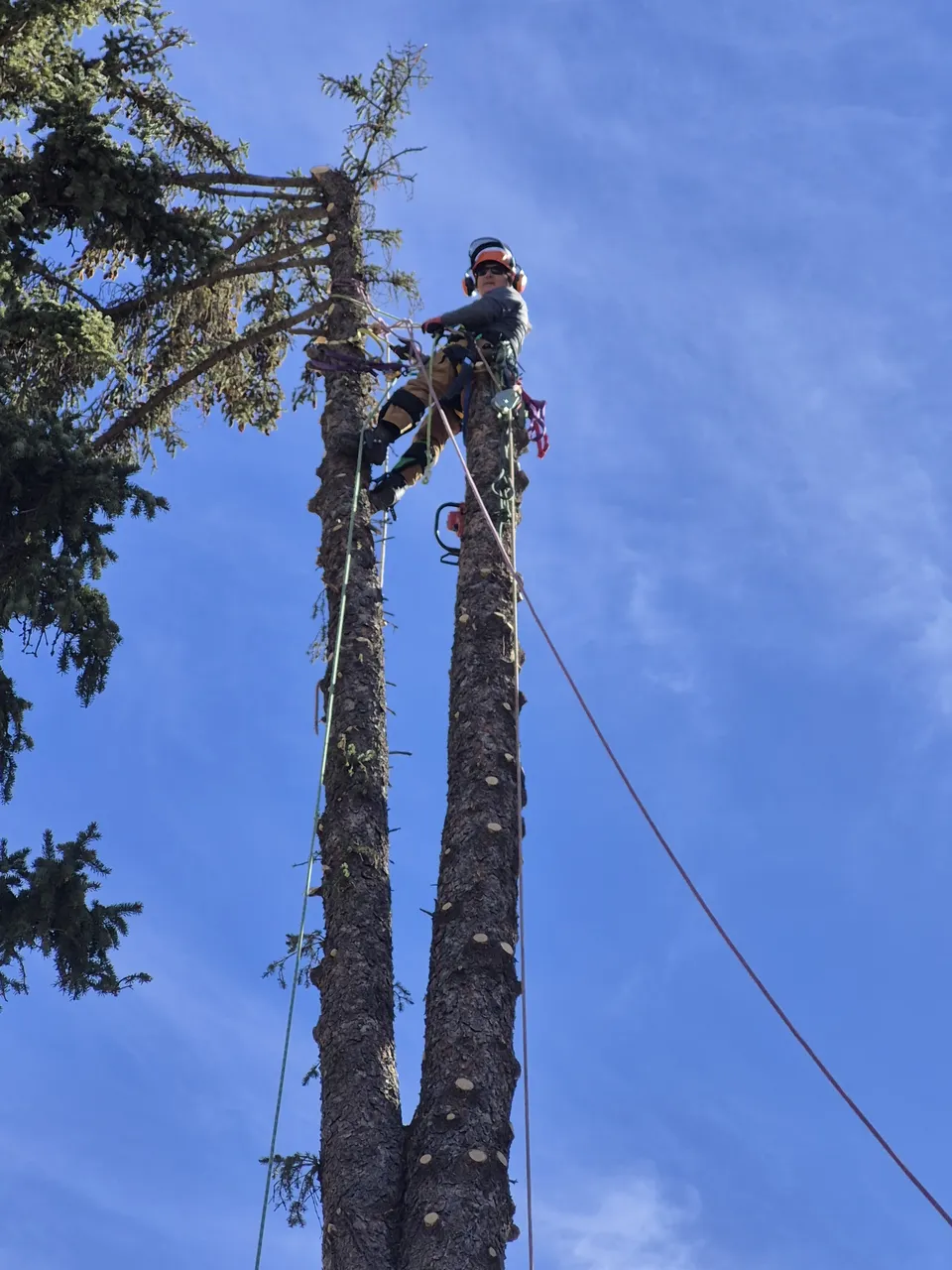
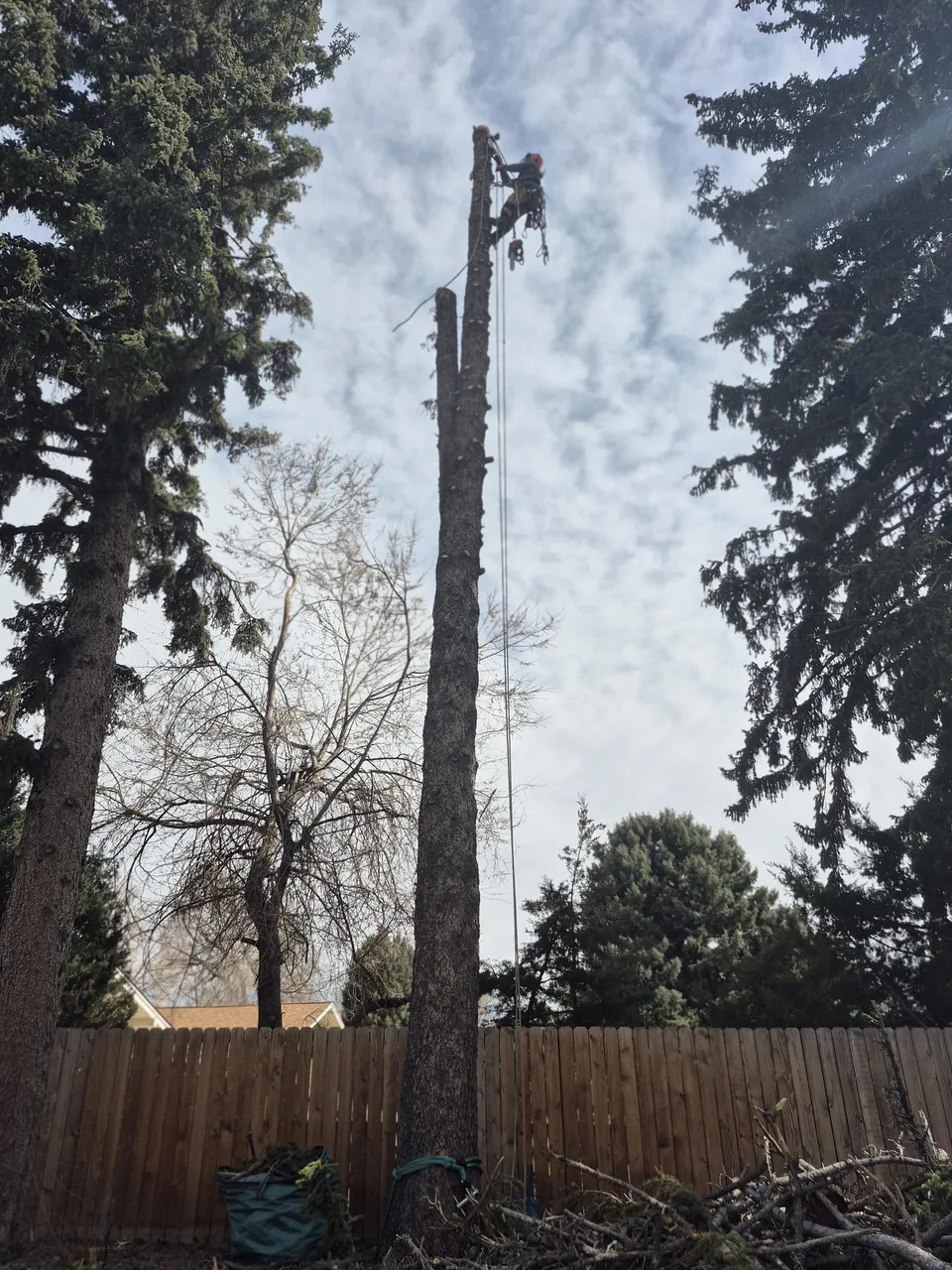
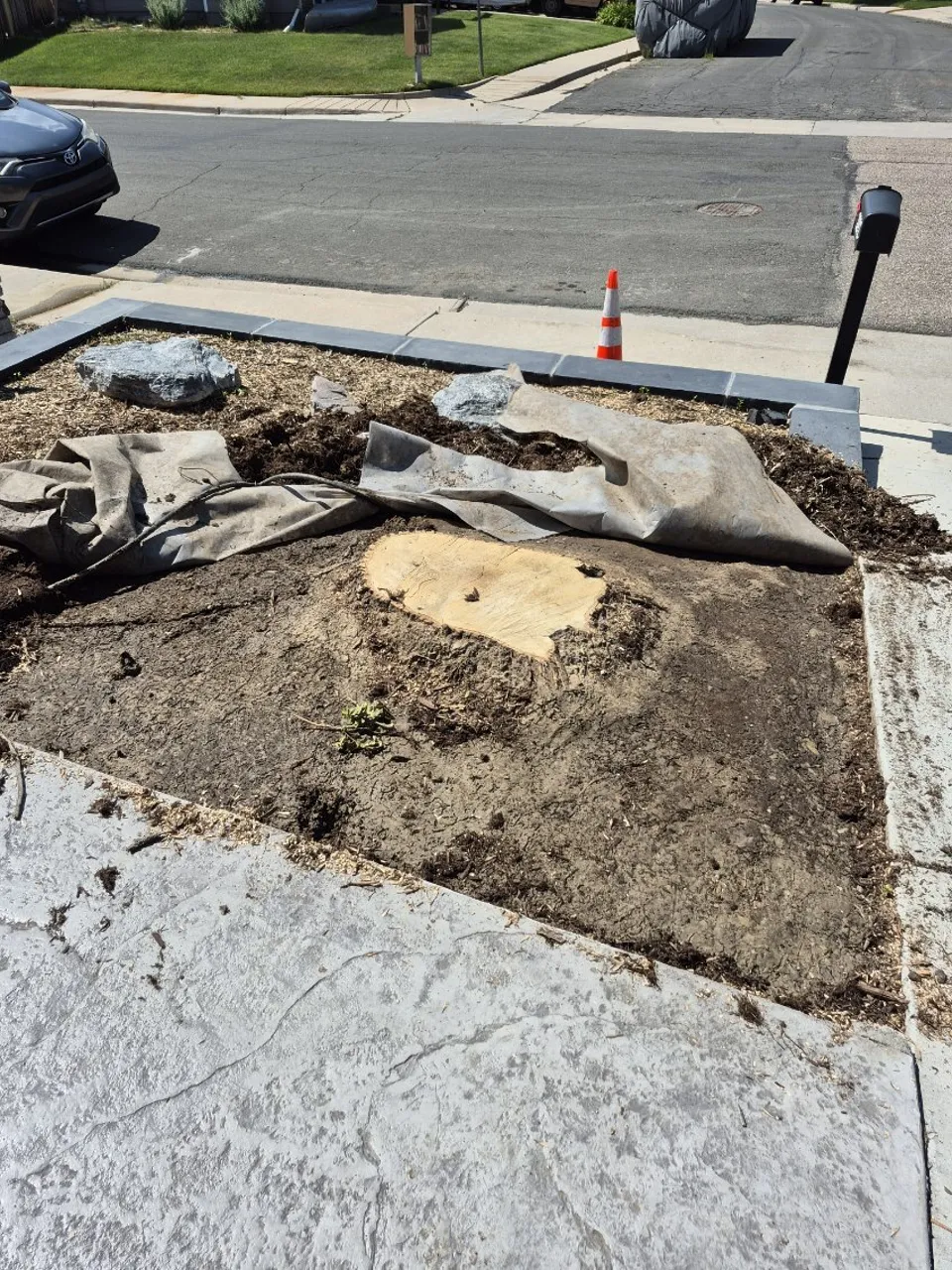
A tree needs to be removed when it's dead, structurally failing, or standing where a failure would hit something that matters. The seven warning signs below — dead limbs, trunk damage, a worsening lean, fungal growth, crown dieback, interior decay, and location risk — cover most hazardous trees we see along the Front Range. Not every sign means removal, but every one means the tree deserves a closer look.
Alpenglow Tree Care is a licensed and insured tree service based in Broomfield, Colorado, serving Denver, the Northern Metro, the Front Range foothills, and the High Country including Summit County and Breckenridge. Colorado is hard on trees: drought cycles weaken root systems, heavy spring snow snaps overloaded limbs, and beetle kill has left standing dead timber across the mountains. Here's how to know when a tree has crossed the line from asset to liability.
1. Large Dead Limbs in the Crown
Alpenglow Tree Care treats large dead limbs as the most urgent sign on this list, because they don't wait for a windstorm. Arborists call them "widowmakers" for a reason — a dead branch 4 inches or more in diameter, hung up 40 feet over your yard, can drop on a calm day without warning.
What it looks like: bare branches with no leaves during the growing season, bark sloughing off in sheets, and gray, bleached wood with the fine twigs already snapped away.
Does it always mean removal? No. If deadwood is limited to a few branches on an otherwise healthy tree, targeted tree pruning removes the hazard. But when more than a third of the major limbs are dead, the tree is telling you where it's headed — and planned removal is cheaper than emergency work later.
2. Trunk Damage: Cracks, Missing Bark, and Cavities
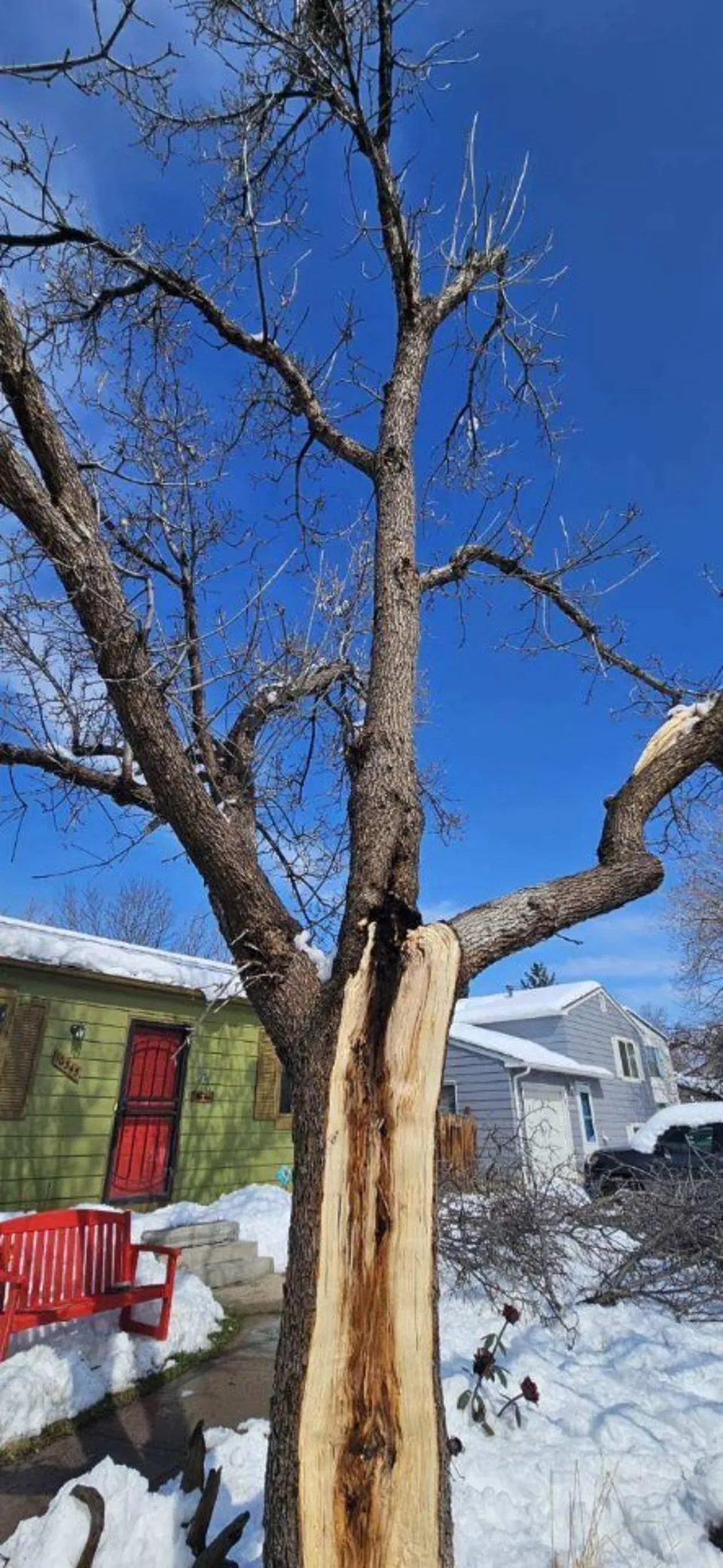
The trunk is the one part of a tree that can't be pruned away, which is why Alpenglow Tree Care weighs trunk defects more heavily than anything in the canopy. Deep vertical cracks, large patches of missing bark (cankers), and open cavities all compromise the column holding everything else up.
What it looks like: a vertical seam you can slide a finger into, bark fallen away to expose smooth dead wood, or a hole where a limb tore out years ago and rot moved in.
Why it matters: general arborist guidance holds that when damage or decay affects a large share of the trunk's circumference — a rough threshold around 25-50%, depending on the tree and what sits below it — the tree can no longer be considered structurally sound. A deep vertical crack is a failure already in progress; it only needs a wind or snow load to finish, and Colorado's freeze-thaw swings widen it a little more every winter.
Does it always mean removal? Smaller wounds on vigorous trees compartmentalize and close. A significant vertical crack, or bark loss around a large portion of the trunk, almost always does mean removal — that's a defect no cable can fix.
3. A Sudden or Worsening Lean
Alpenglow Tree Care distinguishes sharply between two kinds of leaning tree: the one that has leaned for decades, and the one that started leaning last month. The first is often fine — trees grow reaction wood and stabilize a long-standing lean. The second is an emergency.
What it looks like: a trunk visibly further off vertical than it used to be, soil cracking or mounding on the side opposite the lean, or roots lifting out of the ground behind the tree. Heaving soil means the root plate is rotating — the tree is tipping over in slow motion.
Why it matters here: saturated spring soils plus a heavy, wet April snowstorm is the classic Front Range recipe for root-plate failure, and drought-stressed trees with shrunken root systems are the most vulnerable when the moisture finally comes.
Does it always mean removal? A stable, long-established lean can usually be monitored, and a young tree can sometimes be staked and corrected. A fresh lean with soil movement cannot be saved — it needs prompt, professional tree removal before gravity finishes the job on its own schedule.
4. Mushrooms or Fungal Growth at the Base
Alpenglow Tree Care takes fungal fruiting bodies at the base of a tree seriously because of what they reveal: the mushroom you can see is the reproductive structure of a fungus that has spent years consuming the wood you can't see. Root rot and butt rot destroy a tree's anchorage from the inside while the canopy still looks green.
What it looks like: shelf-like conks growing directly from the lower trunk, clusters of mushrooms sprouting from the root flare or major surface roots, or soft, punky wood at the base that gives under a screwdriver.
Does it always mean removal? Not automatically — a lone mushroom in the lawn may be feeding on old buried wood, not living roots. But conks attached to the trunk or root flare indicate significant internal decay, and a tree with rotted anchor roots can fail at the ground line with no warning. This is a case where a professional assessment makes the call.
5. Major Dieback or a Thinning Crown
Alpenglow Tree Care reads the crown as the tree's health report: when the top thins out, leafs late, or dies back branch by branch, the root system or vascular system is failing. Progressive dieback rarely reverses on its own.
What it looks like: sparse foliage you can see the sky through, dead branch tips at the top spreading downward year over year, undersized or off-color leaves, and stress sprouts erupting along the trunk.
Why it matters in Colorado: dieback here is often pest-driven. Emerald ash borer kills ash trees from the top down across the metro — if you have a thinning ash, read our guide to emerald ash borer in Colorado before deciding anything. In the High Country, mountain pine beetle has left hillsides of standing dead lodgepole, and beetle-hit pines around Summit County homes rarely recover once the crown fades from green to red. Repeated drought years compound both.
Does it always mean removal? Early dieback from drought stress can respond to watering, mulching, and care. But once a tree has lost 30-40% or more of its canopy, recovery odds drop steeply and the dead structure overhead becomes the real issue. At that point removal is usually the honest recommendation.
6. A Hollow Trunk or Extensive Interior Decay
Alpenglow Tree Care wants homeowners to know a counterintuitive truth: a hollow tree is not automatically a doomed tree. Trees are engineered like pipes — the outer shell of sound wood carries most of the load, which is why a hollow cottonwood can stand for decades.
What it looks like: visible cavities, carpenter ants trailing in and out of the trunk, a dull thud instead of a sharp knock when you rap the wood, or old pruning wounds that never closed and now open into darkness.
When it matters: the remaining shell has to be thick enough for the tree's size and exposure — and the stakes depend on what's underneath. A hollow tree at the back of a large lot can often be retained and monitored. The same tree overhanging your kitchen is a different calculation, because extensive interior decay leaves no margin for the wind and snow loads Colorado reliably delivers.
Does it always mean removal? No — this sign depends on measurement, not appearance. An assessment determines how much sound wood remains and whether the location allows any tolerance for the uncertainty.
7. Location Risk: When the Target Decides
Alpenglow Tree Care evaluates every defect against what arborists call the target — whatever the tree would hit if it failed. Over bedrooms, driveways, play areas, sidewalks, and power lines, even a modest defect in an otherwise healthy-looking tree can be unacceptable, because the consequence of being wrong is too high.
This is the sign that turns "monitor it" into "remove it." A borderline tree in a low-consequence spot earns time; the same tree over a house does not. We've seen what happens when that call gets made too late — our guide on what to do when a tree falls on your house walks through the aftermath, and our storm cleanup crews spend every spring blizzard responding to failures that were visible months in advance. Removing a hazardous tree on your schedule is safer and cheaper than removing it off your roof.
What to Expect from a Professional Assessment
Alpenglow Tree Care assesses hazardous trees across the Denver metro and the High Country at no charge as part of a free estimate. The visit covers the whole tree: we examine the root flare and soil for movement and decay, sound the trunk for hollowness, evaluate cracks and cankers, inspect the crown for deadwood and dieback, and map every defect against the targets below it.
Then you get a straight answer, which is not always "remove it." Plenty of trees we're called about need pruning, cabling, or a follow-up look next season. When removal is the right call, we'll explain why, quote the job, and schedule it. If you want to budget ahead, our breakdown of tree removal costs in Colorado covers what drives the price — size, access, and condition. Dead trees get more expensive to remove the longer they stand, so a tree showing several of these signs is worth a call this season, not next: (303) 801-7513.
Common Questions About Hazardous Tree Removal
Can a leaning tree be saved, or does it have to come down?
It depends on when the lean developed. A tree that has leaned the same direction for years and grown corrective wood is often stable. A NEW or worsening lean — especially with cracked or heaving soil at the base — means the root plate is failing, and that tree usually needs to come down quickly. Cabling and bracing can help trees with minor structural issues, but they cannot fix a failing root system.
How fast does a dead tree become dangerous?
Most dead trees in Colorado become hazardous within 1-3 years as the wood dries out and becomes brittle. Beetle-killed pines and EAB-killed ash decline faster than average — dead ash in particular gets dangerously brittle within a year or two, which is why many climbers refuse to climb them and require a crane or bucket removal. The longer a dead tree stands, the more it costs to remove safely.
Who is responsible for a dangerous tree near a property line?
Generally, the tree belongs to the property where the trunk stands, and that owner is responsible for maintaining it. If a tree is visibly dead or hazardous and the owner has been notified in writing, they may bear liability if it later fails and causes damage. Laws vary by state and city, so document the condition with photos, notify your neighbor in writing, and consult a local attorney or your insurer for specific disputes.
What does a tree hazard assessment cost?
Many tree services, including Alpenglow Tree Care, assess trees at no charge as part of a free estimate — you get an honest read on whether the tree needs removal, pruning, or just monitoring, plus a firm price for the work. Formal written risk assessments from a consulting arborist, sometimes needed for insurance or legal disputes, typically cost $150-$500 depending on scope.
Last Updated: August 2026